
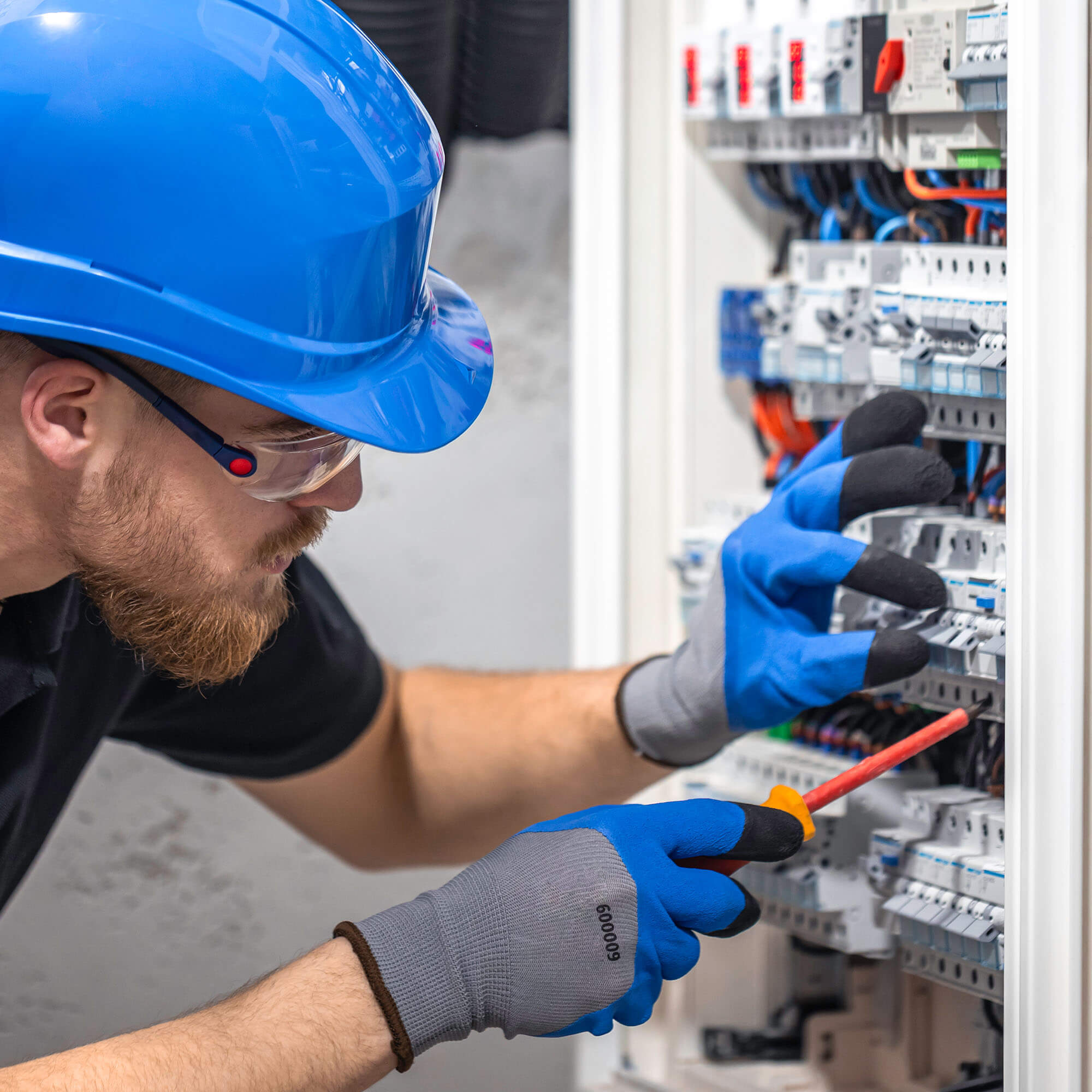
Electrical Services For Every Job
How It Works
Tell Us About Your Project
A few quick questions about your project, your home, and your budget. Takes under two minutes.
Get Matched With Local Pros
We connect you with top-rated contractors in your area who compete for your business.
Compare & Choose
Review quotes side-by-side. Pick the contractor whose price, approach, and timeline feel right. No obligation.
Why Homeowners Use HomesAce For Electricians
Electrical work is not a place to cut corners. The right pro matters more than anything. HomesAce helps you compare upfront quotes from top-rated local electricians with zero obligation.
Up To 4 Quotes
Connect with up to 4 top-rated electricians and start your quote in under two minutes so you can compare hourly rates, parts pricing, and warranty options side by side.
Top-Rated Electricians
Compare top-rated local electricians for projects like panel upgrades, EV chargers, outlet work, and wiring repairs.
Permit Help
Some electricians may help with permits for service upgrades, EV chargers, and panel work, depending on the project and local requirements.
Upfront Pricing
Some electricians may offer upfront or flat-rate pricing before starting work, depending on the job and provider.
No Pushy Sales
You set the pace. Quotes are non-binding and you owe nothing if you decide to wait or scale the job up or down.
100% Free Service
HomesAce is paid by the contractors, not you. Quotes, comparisons, and the matching process cost you nothing.
Smart Electrical Work Pays Off
Prevent Fire Damage
Electrical issues cause about 51,000 home fires per year per the NFPA, leading to $1.3 billion in property damage. Modern panels with AFCI breakers may help reduce fire risk.
EV Home Charging
Installing a dedicated Level 2 home charging station offers faster charging speeds and greater convenience for electric vehicle owners.
Lower Energy Bills
Replacing old recessed cans with LED retrofit kits may help reduce lighting energy use by around 75% to 85%, with possible savings of $100 to $250 per year depending on usage, location, and setup.
Better Insurance Rates
Upgrading from a fuse panel or aluminum wiring to a modern 200A breaker panel may help lower homeowners premiums by around 5% to 15%, depending on insurer, location, and policy details.
Want deeper electrical pricing?
Our full electrical cost guide breaks down costs by job type, panel size, scope, and region, with pricing examples to help you compare options.
Typical Range
$100 – $4,000
National Avg.
$350
Electrical Cost By Job
Prices below cover labor and parts for typical residential electrical jobs. See the full cost guide for whole-home rewires and commercial pricing.
Costs depend on size, materials, local labor rates, and complexity. Get free quotes for accurate pricing in your area.
Get Free QuotesCommon Questions
Frequently Asked Questions
Standard electrician rates run $75 to $150 per hour nationwide, with master electricians in major cities charging $125 to $250. Most electrical companies have moved to flat-rate pricing where they quote the whole job upfront. A simple service call runs $75 to $150 minimum charge plus parts. Emergency calls after hours, weekends, and holidays usually add 50% to 100% to the standard rate.
Most homes built before 1980 have 60 or 100 amp service, which struggles to handle modern loads from EVs, heat pumps, induction ranges, and tankless water heaters. A 200A upgrade runs $1,800 to $4,000 and is required by most utilities before they will install an EV charger or solar system. Signs you need an upgrade: tripping breakers, flickering lights, or any plan to add electric heating or charging in the next 5 years.
Level 2 EV charger installation runs $800 to $2,200 if your panel has spare capacity within 25 feet of the parking spot. Add $500 to $2,000 if you need a panel upgrade or long wire run. Most chargers themselves cost $400 to $800 from brands like ChargePoint, Wallbox, and Tesla. Many utilities offer rebates of $250 to $1,000 plus the 30% federal tax credit in eligible areas.
Whole-home rewiring costs $4,000 to $15,000 and makes sense if your home has knob-and-tube wiring (pre-1950) or aluminum wiring (1965 to 1973), both of which are insurance and fire risks. Modern copper wiring lasts 70 plus years. Aluminum wiring can be made safe with $1,000 to $3,000 of CO/ALR connector retrofits if a full rewire is not in budget. Knob-and-tube should always be replaced when found.
Aluminum wiring was used in single-family homes between 1965 and 1973 due to copper shortages. Look at the cable jacket marking in your panel. The letters AL or words ALUMINUM mean aluminum wiring. Most insurers either deny coverage or charge a premium for aluminum without retrofits. A licensed electrician can inspect for $150 to $400 and recommend full rewire or CO/ALR connector retrofits, which average 30% to 50% of full rewire cost.
Most states require a licensed electrician for any work involving the panel, dedicated circuits, or new wiring runs. Handymen can replace existing outlets, switches, and light fixtures in some states but not in others. The cost difference is small for outlet swaps, $100 to $250 either way. Always use a licensed electrician for any new circuit, new outlet location, or panel work to keep your insurance and resale paperwork clean.
A standard 200A panel upgrade takes 6 to 10 hours including the utility shutoff and inspection. Power is off to the home for 4 to 8 hours during the swap, so plan around fridge and freezer needs. Most utilities require 1 to 3 weeks of advance notice to schedule the meter pull. Permits add 1 to 2 weeks of total project time. Add 2 to 4 hours if your service drop or meter base also needs replacement.
Join thousands of homeowners who saved on Electrical Work!
Ready to Compare Electrical Costs?
Tell us about your project and we will match you with up to 4 local pros today.
Free quotes • Zero obligation • Trusted local pros • Start today
Get Free Quotes

